




City Council: hybrid comments are back, but questions remain
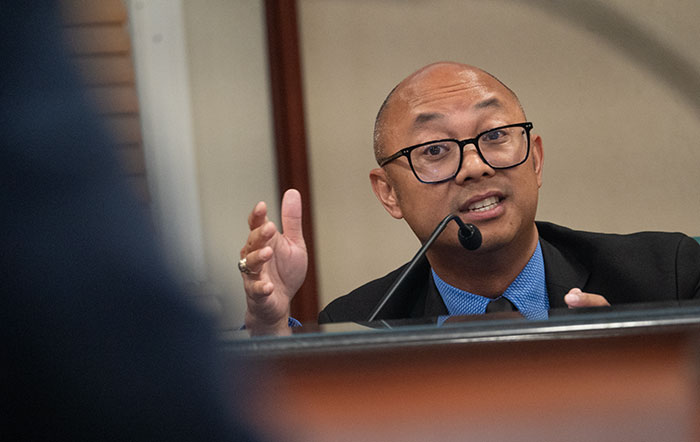
Claremont City Council member Jed Leano at Tuesday’s meeting. Courier photo/Andrew Alonzo
by Andrew Alonzo | aalonzo@claremont-courier.com
The Claremont City Council on Tuesday took steps toward conforming to the requirements of Senate Bill 707, which requires government agencies to offer hybrid meetings by July 1 and to establish policies dictating how remote participation will work.
By a 4-1 vote, council adopted procedures outlining meeting suspension and reconvening protocols, specifically in the event of a disruption of remote participation. Vice Mayor Ed Reece voted no.
“In the event of a disruption in two-way remote participation … the City Council shall recess for no less than one hour, during which time City staff shall make good faith efforts to restore service,” according to a staff report. Should efforts fail, the council will take a vote on if “the public interest in resuming the meeting without remote participation outweighs further delay in conducting the business meeting.”

Claremont City Council voted 4-1 Tuesday to establish policies and procedures on hybrid meeting participation. Courier photo/Andrew Alonzo
Disruptions include technical difficulties that hinder the public from attending or viewing the meeting remotely.
The move was an essential step the city took in conforming to requirements of Senate Bill 707, seven months after California Governor Gavin Newsom signed it into law.
Conversations on policies such as how in-person and remote speakers will share public comment time and/or be prioritized are ongoing among city staff, City Clerk Shelley Desautels said. Next steps include updating language on previous hybrid meeting practices implemented during the pandemic and publicizing them ahead of SB 707’s July 1 deadline.
The city has offered hybrid council meetings since March 2020. SB 707 now mandates it. It also requires the council to host hybrid comment participation, a function that was suspended in October 2023.
The discussion included talk of “Zoombombing,” or taking over a Zoom feed with unwanted, disruptive, or profane speech.
“I think all the agencies are going to have to be prepared that if that practice resumes or if you have other comments that are disturbing, that the First Amendment or the Brown Act does protect those types of comments as long as they’re either within the general public comment or on agenda items,” City Attorney Alisha Patterson said. Patterson added the city can’t police speech during general public comment periods, unless it veers into an area not protected by the First Amendment. The city has more discretion on limiting those who make unrelated comments during deliberations on agendized items.
Questions remain about how the city can police hybrid commenters.
“That’s much harder with remote comments because people can log on multiple times using different names,” Patterson said. “Right now, I don’t know of any way for us to figure out who’s using what IP addresses. And there are situations where you might have different speakers in the same home who want to give comments, and we wouldn’t want to block that from happening because that’s a completely legitimate use of technology.”
By the July 14 council meeting, those wanting to comment via Zoom will be able to “raise their hands,” a feature on the platform, be acknowledged, and speak, Desautels said. Phone participants will continue to call the clerk’s office at (909) 399-5463 prior to the meeting and will be called upon when their item of comment is announced.
Reece cited his experience as a member of California Contract Cities Association’s Executive Board as a reason he voted against the resolution.
“We believed [SB 707] to be flawed and had some elements in it that would … potentially expose our communities and our councils to communication that is unbecoming for a business meeting,” Reece said. “I want to make it clear for the record and for media that it’s not around my restricting people’s access, it’s around the flaws and the really bad legislation.”
Lawyer and Council member Jed Leano noted those who try to rile up council with incendiary comments could be looking for a big payout.
“I am reminded that oftentimes the scheme behind and the intent behind that behavior is to bait us into restricting people’s free speech, and then the capacity then to file civil litigation, collect attorney’s fees,” Leano said. “For some folks, this is nothing more than a money making opportunity.”
Under SB 707, a mayor may remove or limit participation from a person engaging in disruptive behavior, whether they’re attending in person or remotely, and a City Council member may participate remotely due to an emergency, according to Desautels.
SB 707 is scheduled to sunset on January 1, 2030.
Related







0 Comments