




Viewpoint: Village South: there’s more to the story
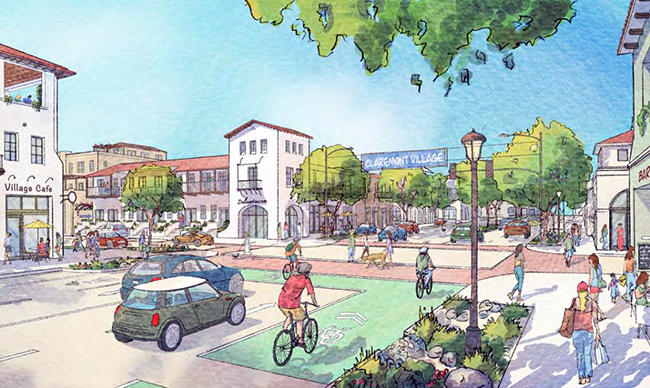
An early rendering of the proposed Village South development illustrates the walkable, mixed-use vision supporters say is at risk under the developer's revised proposal. Image/courtesy of City of Claremont
by Catherine Curtis | Special to the Courier
In last week’s Courier, my fellow former commissioner Susan Schenk described the planning vision Village Partners is proposing to abandon [“Viewpoint: South Village is not what we signed up for”] — the housing mix, the walkable streets, the transit connections, the retail that would have linked the Village all the way south to Peppertree Square. She’s right on all of it.
And there are two additional chapters to this story that deserve their own attention, ones that should concern Claremont residents regardless of where they stand on density or parking. First, the developer’s new proposal could trigger a “no net loss” law that could impact other parts of Claremont. Second, and most basic: we may not yet know whether the ground at Village South is safe to build on.
California law requires Claremont to find locations and update zoning for more than 1,700 new homes by 2029. Losing over 350 of them at Village South — one of the city’s best-positioned sites for transit-adjacent density — could trigger the state’s “no net loss” provision, forcing the city to open up other neighborhoods to much higher density development to make up the difference. The housing pressure doesn’t go away; it might just land in a neighborhood that wasn’t planned for it and isn’t next to a train station. Also, eliminating the planned ground-floor retail permanently forfeits the sales tax those businesses would have generated for city services all of us depend on.
Then there is the ground itself. Recent reports filed with state regulators and publicly available on California’s GeoTracker database at https://bit.ly/3RBE2qp and https://bit.ly/42rQ1t5 found high levels of Trichloroethylene, or TCE (https://bit.ly/4nqw1kc) — a solvent linked to kidney and liver cancer — in soil vapor testing at the former Garner Glass facility, particularly near dry wells where the chemical was reportedly dumped decades ago, before anyone fully understood the dangers.
A 1989 study viewable at https://bit.ly/4djU4fP found trichloroethylene in area groundwater in levels that exceed EPA drinking water limits, though its precise source has not yet been established. The contamination plume has not been fully mapped, and plumes don’t stop at property lines. There are also open questions about the adjacent former Hibbard Chevrolet site — specifically, whether contamination from a paint booth drain, above-ground solvents, and a reported underground fuel tank were ever properly addressed, according to a study, again from 1989, viewable at https://bit.ly/4d8ezxr.
Evidence shows the Los Angeles Regional Water Quality Control Board has been engaged with owners of these sites for decades due to concerns about groundwater. No California Environmental Quality Act exemption authorizes construction over potentially contaminated land before it has been tested and, where necessary, cleaned up. Village Partners is asking Claremont to skip that step.
Whatever your views on housing density, I hope the safety issue is one we can all agree on.
Submit comments by May 22 to cveirs@claremontca.gov. Contact your City Council member. Village South should be what Claremont planned for — not a shortcut that leaves us with less housing and uninvestigated ground beneath people’s homes.
Catherine Curtis is a former member of the Claremont Planning Commission.
Related






0 Comments