




Judo instructor Goltz is grand marshal for city’s Fourth of July parade
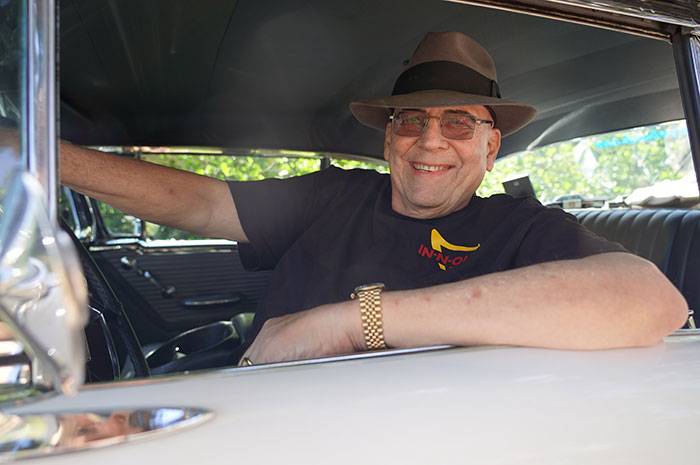
Gary Goltz inside his 1955 Buick Century, similar to the one which was used in the popular 1950s TV show, “Highway Patrol.” Courier photo/Andrew Alonzo
Honoring a sensei to many
By Andrew Alonzo | aalonzo@claremont-courier.com
Claremont’s Fourth of July parade has a new kind of grand marshal this year.
“They’ve always had mayors and stuff do it,” said Gary Goltz. “They’ve never had a contract judo instructor.”
Goltz, 73, will be joined by his wife Sharon and children Callae, Nathan, and Gabe, as well as friends and students from his academy, Goltz Judo on July 4 as they make their way along the parade route from Memorial Park to Larkin Park.
Goltz can talk at length about his previous work as a medical equipment salesman, or his affection for the 1950s TV series “Highway Patrol,” but it’s his near four decades as a judo sensei in Claremont that brought him to the attention of the nominating committee.

Gary Goltz, the grand marshal for Claremont’s Fourth of July parade, pictured among his judo and “Highway Patrol” memorabilia at his Upland home. Courier photo/Andrew Alonzo
“I do want to help society,” Goltz said. “The ultimate goal in judo is to become a perfect character.”
In judo, one must do everything with “maximum efficiency and minimum effort” while also rendering “mutual welfare and benefit” between opponents, Goltz said. His judo course is one of the most popular recreation programs in Claremont, with some 75 youth and adult participants spread among its classes.
“I don’t do it to make money,” Goltz said. “I never did it to make money. I remember what my dad said: ‘Keep it as your hobby.’ And it changed my life.”
As a judo sensei, Goltz said he has an obligation to influence students. And it appears he has done just that.
“It teaches you to take a moment, to not hesitate, to go for things when the opportunity is presented,” said 27-year-old student Zachary Zimmerman of Pomona. “If somebody presents me with the opportunity to do a throw I’m not a big fan of, I’m still going to throw them. And I think that ability to take opportunities as they’re given, even if they’re not exactly what you want but they still get you where you want to go, that … is a valuable lesson.”
Ernesto Sequeira said the course can have long-term benefits on children’s lives, including for his own son, Joshua Sequeira-Liu, who is a student. “This I think for kids at this young age it gives them some kind of structure, something to rely on later in life,” Sequeira said. “When they fail here, they stand up and get up and continue, because life is like that.”

Gary Goltz, grand marshal for Claremont’s Fourth of July parade, with his 1955 Buick Century similar to the one that was used in the popular 1950s TV show, “Highway Patrol.”
Born in 1953, Goltz grew up in Pittsburgh, Pennsylvania. As a kid, he was clearly much more than a typical fan of “Highway Patrol”; he was so entranced by the show that he later became an avid collector of memorabilia. The ultimate expression of his dedication can still be found inside the garage of his Upland home, where the actual 1955 Buick Century used in the show, resides.
His focus shifted in 1965, when Goltz began studying judo.
“I was a wimp,” Goltz said. “I didn’t play baseball, softball, football, basketball, run, do anything; all I did was come home and sit in the house and watch ‘Highway Patrol.’ I was a television guy through and through. No one could change me. And, after I saw that Green Hornet and Kato kicking all those asses, I said to myself, I need to learn how to do that kind of stuff because these kids tend to pick on me a lot.”
He enrolled in a class taught by the late judo legend Kyu Ha Kim at the Jewish Community Center of Greater Pittsburgh. He quickly developed a love for the sport and progressed through its ranks.
“When I started judo, what I liked about it was that all the kids that were already good at sports, they didn’t know anything about judo, so I was on the same level as them for the first time,” Goltz said. “They all quit and I stayed with it, kept staying with it. Eventually, I guess I good at it and I was beating people at tournaments. I got my black belt in my early 20s.”
He later stepped away from judo to focus on his career as a health care executive and entrepreneur for what’s now today known as Apria Healthcare — a $1 billion home medical equipment company. He settled in Upland in 1985.

Gary Goltz leads a judo course at the Alexander Hughes Community Center on June 8. Courier photo/Andrew Alonzo
In 1986 he was accepted to Pepperdine Graziadio Business School’s Presidents and Key Executive Master of Business Administration program. There, he met the late behavioral science professor Wayne Strom, who told Goltz something was missing from his life and urged him to find it.
“He changed my life because at the time I was climbing the ladder in the company and I had abandoned judo because I was huge in the company as a senior executive vice president making over six figures in my late 20s, early 30s,” Goltz said.
Strom instructed him to write about his journey in a journal.
“I wrote how I wasn’t doing judo like I was when I was growing up,” Goltz said. “And he read it that weekend when we were at the class, and he gave me another assignment and said, fix it. Next thing you know, I’m doing judo.”

Gary Goltz leads a judo course at the Alexander Hughes Community Center on June 8. Courier photo/Andrew Alonzo
He graduated from the program in 1988 and went on to teach judo at Chaffey College in Rancho Cucamonga. Soon after he met with Kathy Ables, Claremont’s former youth center director in Memorial Park, to discuss the possibility of bringing the course to Claremont.
He began teaching judo in Claremont in 1990, and never looked back.
Judo has given Goltz “a roadmap to a better life for yourself.”
“I mean, if you’re not moving forward, if you’re not working on a project, if you’re not dealing with a challenge, if you’re not connecting with other people, then you’re dying,” he said. “To me being vital on the mat and judo being vital in the community … being connected to my family, being connected to other people’s families, seeing people triumph when they thought they couldn’t do anything, that keeps me going.”
In 2024, Goltz earned his ninth degree black belt, the second highest attainable in judo.
A full season of instruction at Goltz Judo is $162-$195. Drop-in courses are $17-$22. Go to goltzjudo.com for more information.
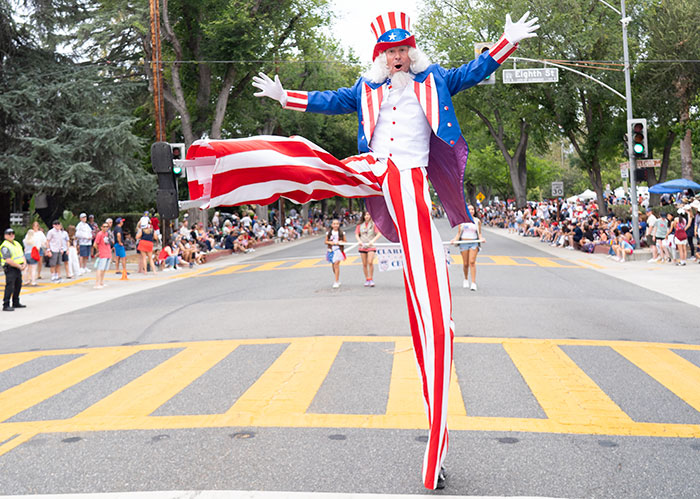
Goltz will be among the City of Claremont’s honorees in its Fourth of July parade. The one-mile parade kicks off at 1 p.m. at Memorial Park, travels south on Indian Hill Boulevard, west on Harrison Avenue, terminating at Larkin Park. More info is at claremontca.gov/activities-recreation.


0 Comments