




Calls for justice in Rios death dominate police commission meeting
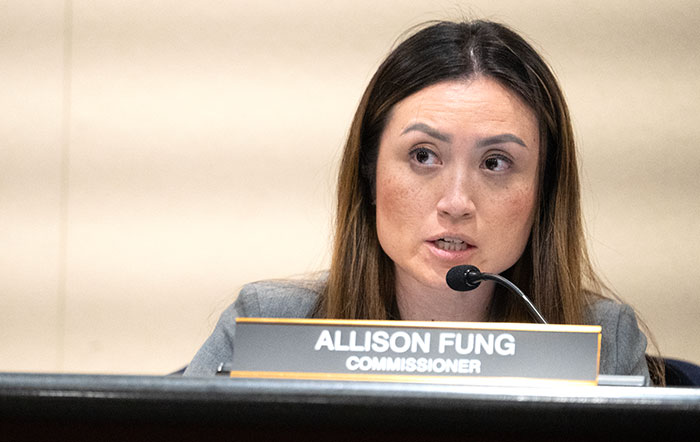
Claremont Police Commission Chair Allison Fung at the April 2 meeting. Courier photo/Andrew Alonzo
by Andrew Alonzo | aalonzo@claremont-courier.com
Calls for justice and accountability regarding the November 2025 death of Diego Rios after a traffic stop by Claremont police dominated the April 2 Claremont Police Commission meeting.
The Los Angeles County Medical Examiner’s Office determined Rios’ death was a homicide. The November 28, 2025 incident involved Rios, Claremont Police Department Corporal Benjamin Alba, and officer Joshua Orona at the intersection of Claremont Boulevard and Andrew Drive. Investigations by the LA County Sheriff’s Department and District Attorney’s Office are ongoing.
On February 17 the Rios family filed a liability claims report form with the city. “The amount claimed exceeds the limit provided in section 910(f) of the California Government Code,” reads the complaint. “This claim will be an unlimited civil case.”
The April 2 meeting came after a January 13 request by Claremont Mayor Jennifer Stark for the Police Commission to agendize a presentation on laws that govern public disclosure of information related to police use of force incidents.

Claremont City Attorney Alisha Patterson at the April 2 Police Commission meeting. Courier photo/Andrew Alonzo
City Attorney Alisha Patterson delivered the presentation, which covered the California Public Records Act, penal code 832.7, Assembly Bill 748 and Senate Bill 1421.
Patterson said, “state law tends to be very protective of the confidentiality of police investigations and police personnel records.” Reasons range from public safety, the integrity of investigations, to privacy interests for survivors, witnesses, and officers.
Prior to 2019, information released as a result of a CPRA request did not include specific information on police investigations or personnel files. AB 748 and SB 1421 changed that. AB 748 mandated that if a CPRA request is filed, barring certain exceptions cities, police, and/or investigators must disclose critical incident audio and video records after 45 days, “unless the agency can demonstrate that the disclosure would substantially interfere with the investigation,” Patterson said. After a year, the agency must demonstrate that releasing the information would interfere with an investigation and reassess that finding every 30 days until all records are released.
SB 1421 amended penal code 832.7, which governs the disclosure of police personnel records such as personal data, medical history, benefits, and complaints, to allow the release of certain records such as investigative reports and evidence. Inside the first 60 days from the date of an incident, cities, police, or investigators are not required to disclose records. After that and up to 18 months however they must, unless disclosure would interfere with a criminal proceeding. “If criminal charges are filed, and if you’re going to trial, then the city is entitled to withhold those records until the trial is completed,” Patterson said. During an administrative investigation, the time frame for disclosure is up to 180 days from the date of an incident unless there is a pending criminal proceeding.

Claremont Police Commission member Aundre Johnson at the April 2 meeting. Courier photo/Andrew Alonzo
Responding to questions from the commission, Patterson said the Claremont Police Department complies with the Brady List, a database maintained by prosecutors that contains names of law enforcement officers with misconduct histories; that it could take a year or more for an investigation to be completed by an outside agency before final findings are disclosable under SB 1421; that Claremont’s staff size can limit how quickly it can communicate a critical incident; and that the release of officers’ information would only take place if he or she has been arrested, indicted, or fired.
During public comment, Claremont Colleges student Macy Puckett and others were critical of Patterson’s presentation and the timing of the meeting.
“This does not convince me that the city or the police department or the commission could not have found a sooner, more accessible alternative platform for the public to discuss how the police department must do better,” Puckett said. “I have seen Ms. Patterson talk explicitly about the legal protections around privacy regarding the employment status of the officers complicit in Diego’s death. But the Claremont community and more importantly Diego’s family has not heard that you will do everything in your power to support his family, get the answers they need, and make permanent change happen.”
A commenter named Jack said, “It’s disrespectful to the public to not expedite this. Yeah, maybe there’s a lack of staffing, maybe that can make it hard to get those records requests, but this needs to be expedited … We’re asking you to do more because the severity of the situation.”
Commissioners hardly spoke at the meeting. Chair Allison Fung did most of it when she announced agenda items, let commenters know their three minutes were up, or thanked them for speaking.
Along with Patterson’s presentation, the agenda included two more items: reports from CPD Chief Mike Ciszek on stats and highlights from 2025 and CPD Captain Robert Ewing on the department’s new citizen records information management system portal, or RIMS.
Ciszek said CPD logged 26,078 calls for service last year, made 985 arrests, conducted 4,710 traffic stops, and took 2,781 reports. The average response time to calls was three minutes, 37 seconds. The chief also touted the department’s outreach and highlighted staff, including officer Jesus Limon, who made 108 DUI arrests last year.
Some commenters took exception to Ciszek’s presentation. After the meeting he responded: “Obviously they’re criticizing and that’s their right to do so and I’m trying to show them that there’s other things that we do to, that just because that we had a tragic event shouldn’t underscore the work that the rest of the men and women are doing day to day,” he said.
The next police commission meeting is set for 7 p.m. Thursday, June 4 in the council chambers, 225 W. Second St.
Related






0 Comments