



Celebrating Route 66
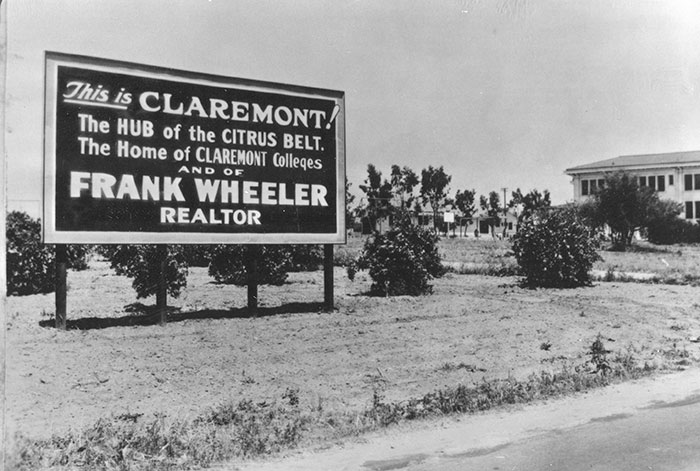
Realtor and community promoter Frank Wheeler was instrumental in securing the designation and funding of Foothill Boulevard through Claremont. The old Claremont High School is seen in the background. Photo/courtesy of Claremont Heritage
by John Neiuber
“On a dark desert highway, cool wind in my hair, warm smell of colitas, rising up through the air. Up ahead in the distance, I saw a shimmering light. My head grew heavy and my sight grew dim, I had to stop for the night.”
The opening lyrics to the Eagles’ “Hotel California” describe traveling west on Route 66, with the glow of the lights from the Los Angeles basin in the distance, beckoning the traveler.
2026 marks the 100th anniversary of the fabled highway, forever commemorated in songs, novels, TV, travelogues, and our memories. I recall the family road trip to Chicago and then on to Wisconsin in my parents’ 1957 Ford Fairlane. We left at 10 o’clock in the evening to cross the desert and avoid the car overheating, and so it would be cooler in the non-air conditioned vehicle, which even at night was barely tolerable.

Frank Wheeler promoted the “Foot-Hill” Boulevard project by entering a float in the 1914 Rose Parade. Photo/courtesy of Claremont Heritage
The centennial celebration kicked off in Springfield, Missouri, the birthplace of Route 66. At 4 p.m. on April 30, 1926 at the Colonial Hotel in Springfield, a group of civic leaders gathered and sent the telegram to Congress requesting the highway be officially designated as Route 66.
This past April 30 at the exact time of the 1926 telegram, Springfield dedicated “Birthplace Plaza” at the corner of Jefferson Avenue and St. Louis Street on the site where the Colonial Hotel once stood. A new mosaic mural was unveiled that reclaims the corner for visitors along the mother road.
Before the nationwide network of numbered highways was adopted, “auto trails” were marked by private organizations. The route that would become U.S. 66 was cobbled together by three existing highways: The Lone Star route that passed through St. Louis to Chicago; the transcontinental National Old Trails Road, but that detoured to portions of the Ozark Trails system and the Postal Highway; and then back to National Old Trails Road from Amarillo, Texas to Los Angeles.
Like all early highways, much of Route 66 was either gravel or graded dirt. Through the efforts of the U.S. Highway Association, in 1938 it became the first highway to be completely paved. Route 66 through Claremont was a dirt road called Mesa Avenue. It became Foothill Boulevard when it was designated a state highway and paved in 1931.
The groundwork for the state highway that would become Foothill Boulevard and Route 66 was laid in 1907, when a connected foothill route was widely accepted — a continuance of the National Old Trails Road. As a result of the groundswell of support, Los Angeles County allocated funds for its planning. In 1910, the state dedicated funds for highway improvement that included a major east-west highway in the area.

Claremont honored local realtor and community promoter Frank Wheeler at the opening day for Foothill Boulevard in 1931. All of Route 66 would be paved by 1938. Photo/courtesy of Claremont Heritage
Locally, the Foothill Boulevard Association was the brainchild of E.W. Reid of Cucamonga, then chairman of the San Bernardino County Board of Supervisors. The other founding members included Frank Wheeler of Claremont. Within a year, the association had grown to 19 cities along the proposed foothill route.
To convince the state to appropriate the funds for a foothill route was a daunting task. In addition, it became a contest, and just like the competition for railroads and routes in earlier times, Pomona and Ontario were spearheading a group to lobby for a southern route that would become a coast-to-coast highway. The members of the association, and Wheeler in particular, spent several years visiting towns from Pasadena to Redlands.
Wheeler was also involved in other promotions of the association. In the 1914 Rose Parade, five Claremont girls were chosen to ride in a rose covered automobile proudly proclaiming the “Foot-Hill” Boulevard Association. No Foothill Boulevard existed at this time, but the promotion in the parade advertised the idea that the major east-west highway should be a foothill route. The efforts of the association proved successful and in the 1920s the California Highway Commission funded the foothill route. Construction began in Pasadena and worked eastward, and the Claremont section was completed in 1931.
Route 66 will be celebrated in a number of ways in Claremont. The Rotary Club of Claremont themed its April 18 Taste of Claremont after Route 66. The city will dedicate a Route 66 centennial commission monument sign in June and install new Route 66 signage and pavement markings. Claremont Cars and Coffee and Claremont Heritage will host a special Route 66 Revisited car show on June 20. In the fall, Claremont Heritage will open a Route 66 exhibition, and the Kiwanis Club will host its Route 66 party at the DoubleTree on September 25.

The corner of Mesa Avenue, now Foothill Boulevard, and Indian Hill Boulevard, seen here in an undated photo, was an unpaved section of Route 66 for many years. Photo/courtesy of Claremont Heritage

Today Route 66 is honored with the Historic Route 66 signs along the 2.2 miles that pass through Claremont. Photo/courtesy of Claremont Heritage
For more information visit the National Centennial Commission’s website at route66centennial.org, or the California Historic Route 66 Association at route66ca.org.
Related
0 Comments