



City Council eases rent burden for 202 households, inks deal with Tri-City
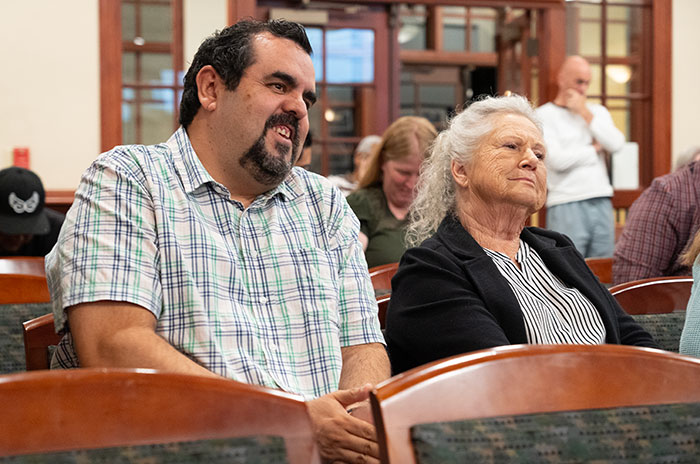
Claremont resident Alexander Valdovinos, a beneficiary of Claremont’s temporary housing stabilization and relocation program, applauds the council’s decision to continue funding the program through December. Courier photo/Andrew Alonzo
by Andrew Alonzo | aalonzo@claremont-courier.com
The Claremont City Council on Tuesday unanimously approved the use of $360,000 from the city’s successor housing fund to cover its temporary housing stabilization and relocation program, helping stave off possible homelessness for some of the 202 households that it benefits, at least through December.
The council also approved a memorandum of understanding between the Claremont Police Department and Tri-City Mental Health Service’s Mobile Crisis Care Team.
Rental assistance
Following emotional testimony during public comment, the council voted 5-0 to continue funding the temporary housing stabilization and relocation program through at least December. The program had been expected to sunset June 30 when the last of the American Rescue Plan Act and general fund monies assigned to it were due to run out. Under the new plan, beginning July 1 the city will inject $360,000 into the program from the successor housing fund, a special revenue fund established in February 2012 as “accounts for transactions related to affordable housing activities,” according to city records at portal.laserfiche.com.

Claremont Police Chief Mike Ciszek speaks on the agreement between CPD and Tri-City Mental Health Services’ mobile crisis care team at Tuesday’s City Council meeting. Courier photo/Andrew Alonzo
The fund’s balance was about $4.1 million as of July 2025. Since then, $1.75 million was set aside for an affordable housing development known as the Base Line Project, leaving the city with $2.3 million to draw from.
Of the rental assistance program’s 202 recipients, 130 are seniors on fixed incomes and 72 are low-income households, according to a staff report. The program distributes $55,000 to $60,000 monthly to property owners to offset recipients’ rent, about $270 to $300 per beneficiary.
The vote to approve the funding was welcomed by loud applause.
Alexander Valdovinos described the vital aid as, “a lifeline that can help us have a semi-decent life.”
“We are a little bit too successful to be able to go ahead and get us any kind of other assistance from any other government institution,” Valdovinos said. “That being said, the renter assistance provided by the City of Claremont has been that godsend to us because it helps us to alleviate a little bit the expenses for rent, which for the last two years has been increased in a 10% manner.”
The council noted that questions remain about how to fund the program past December.
“There are a lot of issues presented tonight,” council member Jed Leano said. “What do we do about the long term solvency of the program? How do we access other interagency and regional bodies’ sources of funding to help address the problems that are here tonight? That’s a work in progress that we’re not going to resolve by July 1 of 2026.”

Claremont City Council member Jed Leano at Tuesday’s meeting. Courier photo/Andrew Alonzo
Deputy City Manager Katie Wand, who presented the agenda item, said the program is a long-term payment assistance service. As such it differs significantly from the yet-to-be established renter protection and homelessness prevention programs from the Los Angeles County Affordable Housing Solutions Agency and San Gabriel Valley Council of Governments that are to be funded by Measure A monies. Those programs are poised to offer legal and relocation services and short-term rental and financial assistance. Income qualifications will also differ from Claremont’s.
Tuesday’s motion also directed city staff to provide interested tenants and property owners information about the upcoming county and regional programs. Mayor Jennifer Stark also requested staff bring back information to the council on rent stabilization.
CPD, Tri-City back in business
The council also unanimously approved a memorandum of understanding between the Claremont Police Department and Tri-City Mental Health Services’ mobile crisis care team, a 24/7, 365 day phone and in-person behavioral health crisis response.
The document — linked on the April 14, 2026 council agenda at portal.laserfiche.com — is a formal framework that outlines the roles and responsibilities of the mobile team, CPD, and the city.
In summary, the MOU states, Tri-City’s mobile crisis care team will respond to calls initiated by CPD and/or Claremont’s Recreation and Human Servies Department and utilize the California Department of Health Care Service’s Medi-Cal Mobile Crisis Training and Technical Assistance Center screening tool to evaluate calls and appropriate responses. With seven dedicated Tri-City respondents and a pool of 125 licensed clinicians to draw on, at least three teams comprised of two clinical staffers and a consulting supervisor will be on hand with respond efforts. Calls will be assessed on clinical judgment, staffing availability, and safety. Once CPD stabilizes a scene, clinicians can engage with callers. “MCC Team will assist as appropriate with crisis coverage on Wednesday, evening, weekends, when City’s crisis team is unavailable, and during periods of high need or when staffing is limited,” read the MOU. Los Angeles County Department of Mental Health’s Psychiatric Mobile Response Team will be called in if Tri-City is unable to respond.
Claremont PD will continue to operate as the primary public safety response in incidents and it, along with city staff, will “call or utilize a centralized City dispatch to contact the TCMHA 24/7 crisis line,” according to the MOU. After CPD confirms it’s safe for a clinician to operate at a scene, they will then maintain a safety prescence and, if applicable, assist with transporting a person to a healthcare facility.
The City of Claremont’s responsibilities under the MOU include providing a space for Tri-City to operate out of, which it already does at 1717 N. Indian Hill Blvd.
Representatives from each party will meet regularly to “review response data, identify system gaps, and enhance joint protocols,” according to the MOU.
The MOU is applicable through June 30, 2027. It is guided by U.S. Department of Health and Human Services Substance Abuse and Mental Health Services Administration’s ever-evolving standards. It will be brought back for renewal next year with applicable updates.
Tri-City Executive Director Ontson Placide said the MOU “does not condition access, limit response, or create a financial obligation for the cities.”
“Billing, if at all, is an administrative process that occurs after services are delivered and does not determine whether services are provided,” Placide wrote in an email. “The Mobile Crisis Team responds based on clinical need and dispatch protocols, not on billing status or city usage levels. The program is fully funded through Behavioral Health Services Act (BHSA) and MediCal funding, and cities do not provide financial contributions to operate this service. A city that calls upon or uses the Mobile Crisis Team more frequently is not asked to contribute additional funding, nor does utilization affect availability of services.” He added that the process of the “New Fisal Year BHSA Integrated Plan” was being reviewed for approval after press time by Tri-City Governing Board.
The next meeting of the Claremont City Council is set for 6:30 p.m. Tuesday, April 28 at 225 W. Second St., Claremont.
Related







0 Comments