




Claremont hunger strike sheds light on conditions at Adelanto
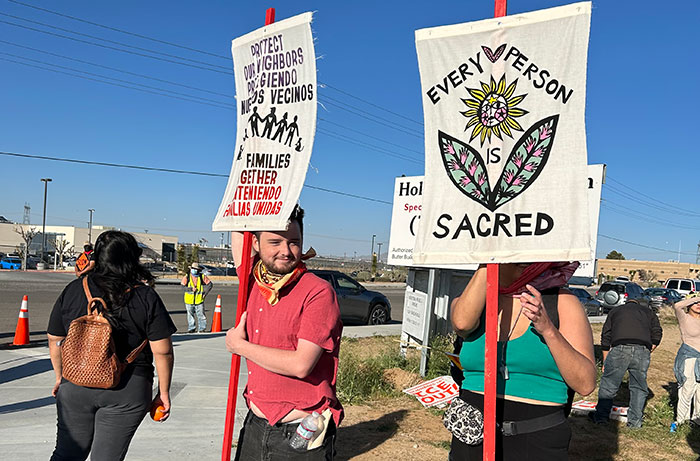
Some 500 people took part in the March 14 Adelanto Caravan and Serenade immigrant rights demonstration outside the Adelanto ICE Processing Center, including these activists from the Inland Coalition for Immigrant Justice. Photo/by Benjamin Wood
by Mick Rhodes | editor@claremont-courier.com
Claremont United Church of Christ parishioners joined in protest this week against what critics have called cruel and inhumane conditions at Adelanto ICE Processing Center, where some 60 detainees are in the second week of a hunger strike to illuminate what they describe as squalid, overcrowded conditions, a lack of clean water, expired or rancid food, inadequate or nonexistent medical care, and scant access to legal representation.
In solidarity, CUCC co-pastors Jen Strickland and Jacob Buchholz and parishioner Benjamin Wood brought the church’s faithful together Thursday for a one-day hunger strike.
Wood is the legal director of the nonprofit Inland Coalition for Immigrant Justice. The Montclair resident has been working with detainees onsite at Adelanto for 11 years, including some of the recent hunger strikers.
“The main request that I got from the strikers was to keep this issue front and center, keep it present in people’s minds,” Wood said. “And inviting members of the congregation or the community to participate in an action like this is a way to keep it front and center in the hearts and the minds of people nearby.”
Strickland and Buchholz began ministering to and assisting Adelanto detainees prior to 2020. “The church helped bond several people out, helped them get work permits, helped them get a new start,” Buchholz said.

The Adelanto ICE Processing Center. Photo/by Benjamin Wood
The second Trump administration’s sometimes deadly crackdown on immigration has spurred a new kind of activism at CUCC.
“We just felt like the church needed to stand in solidarity with these people as these private prisons continue to make conditions in these detention centers deplorable,” Buchholz said. “… No matter your stance on immigration, this country, the United States, does not have to treat people inhumanely. And not giving people access to healthcare or food or allowing their asylum cases to be heard in a timely manner is not how we should act regardless of our politics.”
According to the nonpartisan, nonprofit Transactional Records Access Clearinghouse, as of April 4 the federal Immigration and Customs Enforcement agency was holding 60,311 people in detention nationwide. Of those, 70.8% have no criminal convictions, and most who do have records have been convicted of minor offenses such as traffic violations. Texas leads the nation in ICE detainees with 17,908. California has 5,807 in detention. The private, for-profit GEO Group owns and operates the Adelanto ICE Processing Center and lists its capacity as 1,940 and current occupancy at 1,733. Immigrant advocates and lawmakers contend the number is actually in excess of 2,000.
U.S. Representative Judy Chu was among a group of lawmakers who visited with hunger strikers inside Adelanto last week. Shortly thereafter, GEO Group management reportedly retaliated by putting a number of the strikers into administrative or disciplinary segregation, barring them from yard time, and even shutting down their electricity, which meant detainees had no way of communicating with their families and/or legal representatives.
Chu told the San Bernardino Sun, “The fact that they are being punished for speaking out about these conditions only underscores the cruelty and corrupt management of a facility that is profiting off of their suffering.”
Meanwhile, GEO Group denies both the existence of hunger strikers at Adelanto and that conditions are substandard, telling Southern California News Group: “There is no hunger strike at Adelanto, and no one is being abused. Members of Congress should be looking after the needs of their American citizen constituents rather than creating divisive false media narratives.”
Wood, who was inside Adelanto last week, disputed GEO Group’s characterization.
“There’s mold everywhere in those facilities,” Wood said. “The water jugs, they’re basically not clean, so they get a slime on the inside, and it’s just not sanitary; it’s not safe for human consumption.” Wood also said his clients are telling him the food served to detainees “is horrible,” including a salads with rancid, black lettuce. “And for the Muslim detainees, there’s not really any such thing as a halal meal. It’s just slop. They complain that it’s like dog food.
“I have one guy that did develop some stomach problems, and then they prescribed him some medication and it was expired.”
ICE contracts with three for-profit prison companies that run eight detention facilities in California — GEO Group, Core Civic, and Management and Training Corporation. GEO Group and Core Civic donated a combined $2.8 million to Trump’s 2024 reelection campaign. In 2025 alone, GEO Group was awarded more than $2 billion in ICE contracts and Core Civic $653 million.
In response to growing public outcry, the California Assembly is pushing three bills designed to disincentivize for-profit private prison companies from operating in the state. One of which, AB1633, aims to “impose an annual tax on each private detention facility operator, as defined, equal to 50% of the operators gross receipts.”
And as state and local lawmakers scramble to react to the multitude of legal issues surrounding the ongoing federal crackdown on immigration, activists, lawyers, faith leaders, and regular folks are left to deal with the morality of it all.
“I think the system, these private prison systems, are designed to separate these people that are being detained, for whatever reason,” Strickland said. “They’re designed to separate them and separate those of us who are not being detained and to create this boundary and this separation and say, ‘These people are different from everyone else.’
“And I think our mission as people of faith is to remind ourselves that we’re not separate. These are our neighbors. These are people that have children. These are people that have parents. These are people that are connected to us through our society and through the places we live and work and play. And if they are suffering, then that is our responsibility to not turn away and ignore that, but to remember that our faith calls us to care for these people and to remember that we’re united as one body of humanity.”
Those interested in joining CUCC in support of Adelanto detainees can do so by accessing the church’s solidarity hunger strike toolkit at claremontucc.org.
Full transcripts of interviews with Strickland, Buchholz, and Wood are at claremont-courier.com.
Related






0 Comments