




One step closer to Mercy Claremont: housing project is 50% funded
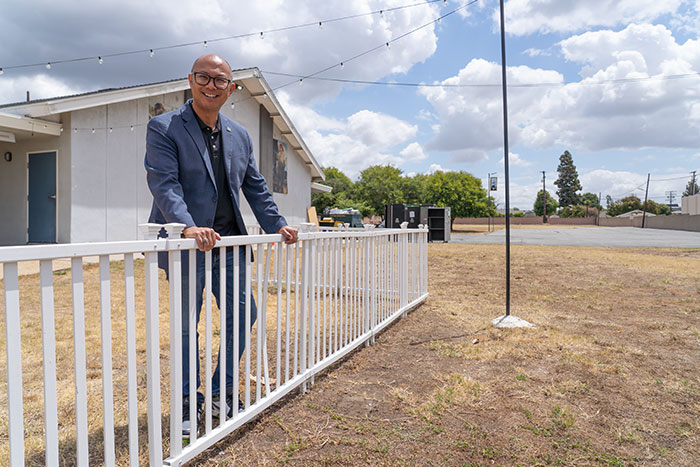
Claremont City Council member and LA County Affordable Housing Solutions Agency board member Jed Leano at the planned site of Mercy Claremont, an affordable housing project at 1364 N. Towne Ave. Courier photo/Andrew Alonzo
by Andrew Alonzo | aalonzo@claremont-courier.com
As a member of both the Claremont City Council and the Los Angeles County Affordable Housing Solutions Agency, it’s been a pretty good couple of weeks for Jed Leano.
On May 13 the affordable housing agency announced the allocation of $256,487,393 for 20 affordable housing projects in LA County, with $19,362,273 earmarked for Mercy Claremont, a multi-story 74-unit mix of rental apartments with one-, two- and three-bedroom floorplans at 1364 N. Towne Ave.
The new funds for Mercy Claremont represent about 1/3 of its overall cost of $62.4 million. The project is about 50% funded, including some $6 million from the state of California, $3 million from Los Angeles County Development Authority, and another $3 million from San Gabriel Valley Regional Housing Trust.
The $31.2 million shortfall will come from state low income housing tax credits, which are the “number one source of financing for affordable housing” in California, according to Leano.
“Now that we have the LACAHSA award, our next step will be to submit for tax credits, which is the main component that funds most of the affordable housing that we do,” said Erika Villablanca, Mercy Housing’s director of real estate development. “We cannot submit an application to that program until September, which is their next round.”
If the credits come through, Villablanca predicted the project will break ground by summer 2027.
Fifty-four of Mercy Claremont’s 74 units are for families with a veteran head of house, 19 for previously unhoused veterans, and one for an onsite manager.
“Amenities will include indoor community space, management and resident services offices, laundry facilities, outdoor community gardens and children’s play areas, on-site property management, and Resident Services programming with dedicated staff to support residents,” according to an overview of the project at mercyclaremont.org.
TCA Architects will design the project and Mercy Housing will manage it. Supportive services are to be coordinated by New Directions for Veterans, the Veterans Affairs Greater Los Angeles Healthcare System, and Mercy Housing.
The property last sold for $4.55 million in 2023 and was identified as an opportunity site in Claremont’s latest housing element.
Larkin Place, the city’s most recent affordable housing project which opened in March, saw considerable community opposition before it finally broke ground. So far pushback against Mercy Claremont has been minimal, Leano said.
The more than a quarter-billion dollar injection for Los Angeles County Affordable Housing Solutions Agency came from Measure A bonds, the half-cent sales tax measure passed by LA County voters in 2024 meant to address housing and homeless services, which went into effect in April 2025.
“The significance of this bond is that we are literally acting like our own bank,” Leano said. “So [Los Angeles County Affordable Housing Solutions Agency doesn’t] receive $255 million in revenue to give out. What we are doing is we are issuing bonds. And that was authorized to allow us to use the bond proceeds, the sale of those bonds, to fund the projects. And we’re paying those bonds back with our Measure A revenues. So, rather than going to banks and asking for funds and partnering with us, we are the bank.”
Overall, the agency expects to build 1,530 affordable housing units across the 20 LA County projects, serving 3,150 low and moderate income persons, according to Claudia Lima, chief strategic investment officer at LACAHSA.
The total cost of all 20 projects is just over $1 billion.
The agency’s quarter billion-dollars in Measure A money is meant to get projects over the finish line.
“We needed to identify those projects that could break ground within 12 months,” Lima said. “And then we were looking for projects that already had a substantial amount of capital in place so that our capital comes in and then we are the push that makes this project move forward.”
While the agency is confident its 20 projects will break ground, essential final funding — via state tax credits — remains an unknown.
“It’s an application process. There’s scoring criteria. There’s points that we have to meet,” Villablanca said. “There’s a list of 20,000 things that we have to submit. It’s competitive. It’s not guaranteed.”
LACAHSA Chief of Staff Tommy Newman described the more than quarter billion-dollar allocation as a “unique moment and really special moment in the history of LA County.”
“It’s a long time coming because historically speaking we have underinvested in housing solutions,” Newman said. “We haven’t tried to bring countywide strategies or countywide resources; it’s sort of been every city for themselves … LACAHSA helps change that whole paradigm and creates predictability, creates stability, and allows us to really level up our game countywide when it comes to making housing more affordable and supporting people who are at risk of losing their homes.”
Developers competed for the LACAHSA funding and were selected based on their history in building affordable housing, already committed funding sources, cost containment per unit efforts, location, equity, and the ability to break ground within 12 months.
Leano said the tenant population served in these projects was important, but not a decisive factor.
“What we did not want to do in making the allocation decisions was come to [decide] some populations were more worthy than others,” Leano said. “We do know that if you don’t at least pay some attention to that, it is possible that some subpopulations long-term can be underserved by your programing, and we don’t know until a couple of rounds are completed whether that will be the case, and we certainly do not want that to be the case.”
Related







0 Comments