




The Garner legacy: Bess and Herman Garner
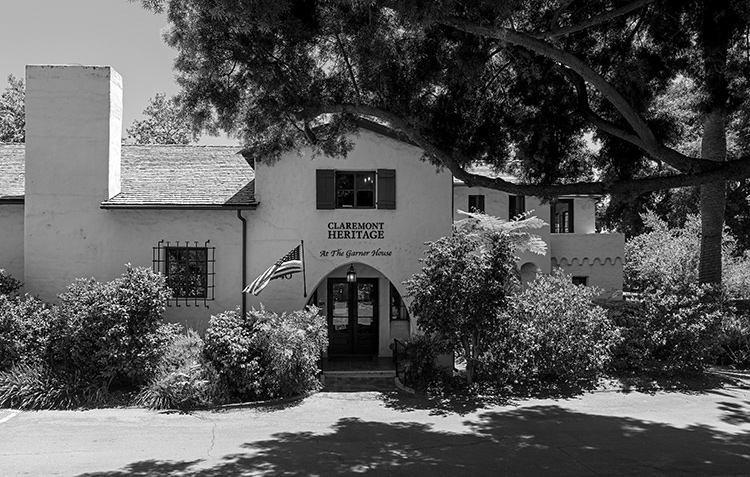
During morning hours the Garner House is in partial shade due to the wide variety of mature trees surrounding the property. Courier photo/Peter Weinberger
by John Neiuber
Herman Garner was born in Marysville, Tennessee in 1886 and was a resident of Claremont for 77 years. Born in Michigan in 1887, Bess Fern Adams’ parents moved to Pomona when she was very young. Her father became prominent in the citrus industry. She and her four brothers attended local schools and graduated from Pomona High School. It is fitting and appropriate that Bess Adams Garner, who was called “Mrs. Claremont” by many, was born in 1887, the year Claremont was founded.
Herman and Bess met while attending Pomona College. Bess was elected to Phi Beta Kappa and was the only woman to earn a letter as a member of the debate team. They graduated in 1910. In 1912, after Herman returned from Cornell, where he earned his master’s degree, they were married. During their first year of marriage Bess taught school near Chino at the Spanish speaking village of Prado. She noted later that this experience was “the inspiration for her study of the early history of Southern California.” Herman was teaching high school at the time.
He was not a teacher for long. Using his background in engineering, he started his own business, Pomona Air Cleaner, in 1918. The business started small, manufacturing air cleaners for agricultural equipment used in the citrus industry. In 1922, responding to a demand for cleaner intake systems, he designed and produced the first oil bath air cleaner for tractor engines. The air cleaner design featured a swirling action of air, or a “vortex,” still the main design principle of air cleaners today. It was also the vortex action of the air cleaner that gave the company a new name; changing the “e” in “vortex” to “o,” in 1924 it became Vortox Manufacturing Company.
The Garners moved to Claremont in 1925, and in 1928 Vortox moved into its new building on Indian Hill Boulevard. The company flourished, and by the beginning of World War II and through the Korean War Vortox was a principal designer and manufacturer of air cleaners used on armored personnel carriers and tanks. The company served many industries, including oil, automotive, trucking, electromotive, alternative fuel, agriculture, industrial, and defense.
Bess Garner played a role in the political life of the city, specifically where it involved youth. She served as an officer and president of the Claremont Grammar School (now Sycamore Elementary School) PTA, and was elected to the school board for eight years, serving as president during her tenure. She was involved with The Claremont Church youth program and served on Claremont’s Post-War Planning Committee, a body that had a profound effect on shaping the city after World War II. She was also instrumental in establishing the first youth center on the grounds of her former home in Memorial Park.
Herman served as the president of the Padua Hills Company, which had developed from an effort to save the foothills for community use. Twenty public spirited citizens, representing college trustees, faculty, church leaders, business, townspeople, artists, and writers pooled their resources and bought approximately 2,000 acres. In 1930, the decision was made to use a portion of the land to subdivide, and that a community center was needed. The company’s vision was that it would be a community of artists, writers, and craftsmen with the education, background and disposition to appreciate the location. The theater became the community center of the little enclave at Padua Hills.
Bess devoted much time and effort to the cultural enhancement of Claremont. When the Claremont Community Players were in search of a temporary home, she opened the doors of her home for rehearsals. The players were looking for a permanent home and construction of Padua Hills Theatre was financed by the Garners in 1930.
Originally, a group of young local men and women of Mexican descent who came to Padua to work in the dining room would sing during dinner. Under Bess Garner’s direction they would perform in the theater on Community Players’ dark nights. As the Great Depression hit Claremont, the Community Players dissolved and Bess Garner took control of the situation so the theater would continue operating, becoming the writer and director of Mexican folk productions. Padua Hills Theatre and the Mexican Players became known throughout Southern California.
After some time, new talent arrived from Mexico to teach the local performers the authentic music and dance from different regions. As Bess delved more and more into its culture, she embarked on many trips to Mexico. She wrote dozens of articles for the Claremont Courier and Pomona Progress Bulletin about her trips. In 1937 she traveled 15,000 miles in Mexico and Guatemala searching for authentic native costumes, dances, folk dramas and talent. Her travels resulted in her first book, “Mexico — Notes in the Margin,” published in 1937, which was a compilation of her newspaper articles. She also wrote “Windows in an Old Adobe” about the Palomares and Vejar families of the rancho days.
During World War II, Bess responded to the needs of the era. She became active in the Red Cross and helped organize the Grey Ladies to meet the needs of servicemen staged at Los Angeles County Fairgrounds (now Fairplex). When the Garner House and property were sold to the city in 1946 and became a park, the couple divorced and Bess Garner left the Padua Hills Theatre. She continued her service to Claremont youth, The Claremont Church, and her travels to Mexico. During a respite from her bout with cancer, she spent three months in Mexico before her death in 1951.
When Herman Garner died in 1981, real estate agent Mack Parks said, “He deserves the credit for not allowing the hills to be developed just as an ordinary real estate development. I believe he was offered a large sum of money for the property many years ago so that it could be developed, but he refused to do it. He had an idea — he wanted Padua Hills to be really beautiful.”
The Courier said of Bess after her death: “The term ‘community service’ finds its fullest definition in the life of Bess Garner. There is hardly a field of community activity in which she was not identified. It is not possible to measure the part Mrs. Garner has played in important things. And through it all she remained the same lovable, understanding person often working far beyond her strength spurred by a devotion which characterized her concept of values.”
Related






0 Comments