




CUSD pitches potential $77 million bond measure
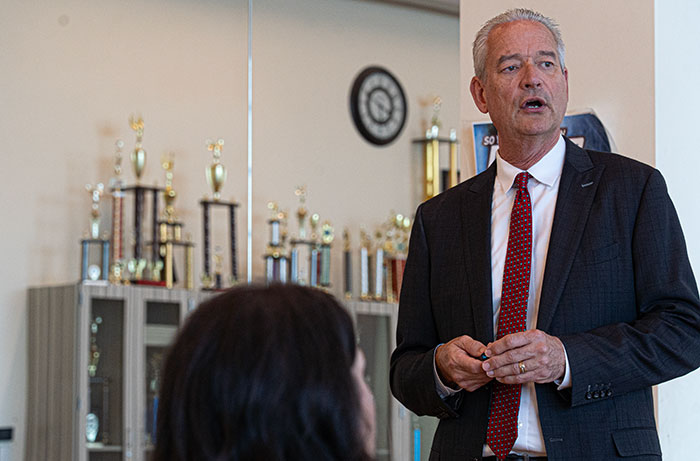
CUSD Superintendent Jim Elsasser answers questions from stakeholders at an April 30 information meeting to discuss a potential new $77 million school bond. Courier photo/Andrew Alonzo
by Andrew Alonzo | aalonzo@claremont-courier.com
Claremont Unified School District officials offered more details about a potential new $77 million school bond measure last week.
Superintendent Jim Elsasser said in February it would “make a commitment … to only charge what taxpayers are currently paying on Measure Y, which is $31.96 per $100,000 of assessed [property] value.” Money raised would pay for aging infrastructure and safety needs across CUSD’s 10 elementary and secondary campuses, all of which are more than 60 years old.
“The reason we’re doing these meetings is because the board has asked staff to engage the community in a discussion around our facilities and whether there’s potential support for a bond in November,” Elsasser said to the dozen or so attendees at the April 30 discussion at Claremont High.
The ask comes at a time when money is tight, with the district mired in a near $11 million deficit for fiscal year 2025-26, with more red ink projected in the coming years.
Elsasser and CUSD Assistant Superintendent of Business Services Desiree Reyes took turns explaining elements of the bond at the meeting.
Reyes said CUSD is looking to generate local money to maintain its infrastructure as most state and federal dollars it receives go toward other expenses. She broke it down thusly: 86% of revenue goes toward payroll and 5% covers utilities and property and liability insurance, leaving 9% for everything else.
“So, what does that mean?” Elsasser said. “It means we don’t have millions of dollars left over to invest in our facilities.”
The district continues to survey residents at bit.ly/4lx26Wq?r to gauge buy-in on the potential school bond. The Board of Education will hear the survey results at its June 4 meeting. It could vote on the matter as soon as June 18, depending on the results of the survey.
“If [survey participants] believe they should proceed with the bond, then we’ll bring a resolution back to the board on June 18, and if they pass that resolution, that’s what starts and gets us onto the ballot on November 3,” Elsasser said.
The next community discussion of the potential school bond is set for 6 p.m. Wednesday, May 13 at El Roble Intermediate School’s multipurpose room, 665 N. Mountain Ave., Claremont.
The potential new bond would be a familiar expense to taxpayers, as they are already paying for two previous CUSD bond measures, Y and G. Passed in 2000, the $48.9 million Measure Y bond will be retired in 2028. Measure G, passed by voters in 2016, runs through 2048. Measure CL, a proposed $95 million bond earmarked for upgrading buildings and equipment, was rejected by voters in 2010.
“We know that the community really couldn’t tolerate paying on three school bonds at one time,” Elsasser said. “But they’ve been paying on two for the last eight years. So, our thought was what if we keep the dollar amount the same, what everyone’s paying on Measure Y right now, and we go and have it hit the tax rolls in 2029 after measure Y falls of in 2028 … You never feel a decrease, you never feel an increase, you just keep paying what you’ve been paying over the last eight years.”
Should CUSD’s Board of Education agree to include in on the November ballot and 55% of voters support it, district projections indicate it will raise $77 million over 30 years.
That figure falls short of the $81 million CUSD projects the work will cost. And the $81 million figure only includes the most urgent projects as identified in a 2025 facility needs assessment by PBK Architects.
The district is pursuing state facilities bonds to make up the shortfall, but that funding would not come until 2030 at the earliest.
“… We’re looking at an additional $7 million that we’re eligible for,” Reyes said. “And so that comes in potentially in the next five or so years, that will help us as well fill in that gap to get to those projects that we aren’t able to get to necessarily with the bond money.”
The estimated cost of work also does not factor in “escalation,” or inflation in labor or materials, Elsasser said.
“What’s important to know is we have to consider that $81 million really you have to consider $102 million,” Elsasser said, “because $81 million would be if you did all the work today and wrote the checks. But we know the kind of projects that we will engage in will take 4 or 5 years to complete, so you have to build in escalation.” Elsasser did not say how CUSD would make up this additional projected shortfall, should voters pass the bond.
Potential projects the bond would address include outfitting campuses with security cameras; remote and keycard accessible doors; creating single points on entry on open campuses during the school day; automating irrigation and heating, ventilation, and air conditioning controls; HVAC improvements; updating classroom interiors such as carpets, paint and furniture; restroom improvements at secondary school sites; repairing and improving exterior building surfaces and windows; replacing roofing, switchgears, electrical panels; replacing CHS’s turf field; and replacing boilers, chillers, and piping at Claremont and San Antonio high schools.
“We’re looking at end of life [infrastructure] like the roofing, that’s not a routine maintenance, or plumbing,” Reyes said.
District spokesperson Elaine Kong said the potential bond proposal would “include clear project descriptions and public accountability measures so taxpayers can track how funds are spent.”
Reyes said Monday the district would not use its reserves to fund projects should voters approve the potential bond in November.
Related





0 Comments