




CUSD report: unions push for raises, parents for screen limits
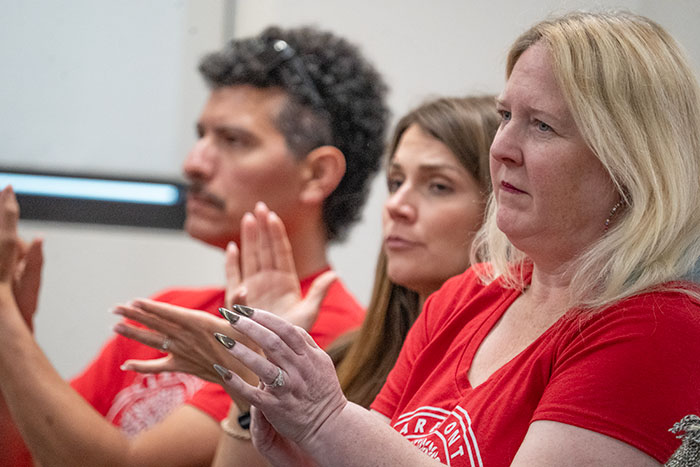
Claremont High School teacher Wendy Crilly, right, was among the Claremont Faculty Association members advocating for teacher salary increases at the May 7 CUSD Board meeting. Courier photo/Andrew Alonzo
by Andrew Alonzo | aalonzo@claremont-courier.com
As teachers continued to rally for salary raises, a group of parents pressured Claremont Unified School District officials to consider new guidelines on screen time on school-issued technology at the May 7 CUSD Board of Education meeting.
Teacher salaries
Representatives from Claremont Faculty Association and the California School Employees Association continued to advocate for salary increases. Teachers reiterated earlier reports of continued low morale on campuses, increased workload, cost of living increases, and concerns about minimal salary increases over the last few years.
“Our cost of living goes up just like everyone else’s,” said Claremont High teacher Wendy Crilly. “So when you deny us our fair share of the [cost of living adjustment], you are making it harder for us to pay our bills and not live paycheck to paycheck. My bills have been increasing, but my pay has not been increasing at the same rate. I now have to live with the guilt of being thankful for the life insurance money left to my daughter when her dad died. I am thankful for this because I would not have been able to pay for college without going into considerable debt.”
Negotiations between CUSD and its employee unions are ongoing, according to CFA president Brian D’Ambrosia-Donner. The outcome will likely be revealed in June as the district finalizes its 2026-27 budget.
Slow tech families
During public comment several parents of elementary schoolers raised concerns over students’ screen time and usage of school-issued devices in the classroom.

(L-R) Claremont Unified School District Board of Education President Alex McDonald and Superintendent Jim Elsasser heard concerns from teachers and parents at the May 7 meeting. Courier photo/Andrew Alonzo
Beginning in seventh grade, all CUSD students are furnished with iPads. Tech policies vary at the district’s elementary schools. For those primary students who do receive iPads, classroom teachers have access to tools that allow them to see what’s on students’ screens and hide apps, CUSD Director of Educational Technology and Innovation Kara Evans said. Outside school hours, parents have access to similar controls.
Commenters questioned the district’s use of applications such as i-Ready at the elementary level, claiming it results in learning inconsistencies and adds to students’ overall device usage. The app by Curriculum Associates is widely used among elementary schools, according to Evans, providing the district with benchmark data on where students are in English language, arts, and math.
“The recommended use of i-Ready is 45 minutes a week and that is something that we insist on,” Evans said. “If we see teachers that are using i-Ready for more than 45 minutes a week, then we’re having a conversation with them because that really is a best practice.”
Beyond that, Evans said the district does not have a screen time policy.
Jules Bernstein, senior research communications manager at UC Riverside, was among those who spoke during public comment.
“I’m urging [the Board of Education] to take decisive action by limiting screen time, eliminating ineffective technology, and ensuring parents have the right to opt out,” Bernstein said. “Our children’s healthy development should be our absolute priority. Let’s make our schools a sanctuary for deep learning and focus, not a source of digital distraction and distress.”
Parents cited research linking excessive screen time and device usage to declines in academic and cognitive growth and physical and emotional health.
Michiko Hori, founder of the “slow tech families” group at Sycamore Elementary, also spoke.
“The issue with [tech] is the delivery of learning via technology,” Hori said. “Why do we have to deliver math, reading, essentially everything through technology?”

Kara Evans, Claremont Unified School District’s director of educational technology and innovation, with an El Roble Intermediate School student in January. Photo/courtesy of CUSD
“Our idea of technology use is not about volume; it’s really about the how,” Evans said. “Other districts are going to do what they do and they may come at it from different angles than we do, but I would say that the idea of limiting screen time — just putting a blanket limit on screen time — negates what we really want students to do in the classroom, which is be creators of content, not consumers of content.”
On April 21 and following pressure from Schools Beyond Screens, a national coalition pushing for guidelines on technology in the classroom, Los Angeles Unified School District’s Board voted to develop a screen time policy. Should it be approved in June, it would go into effect across LAUSD campuses in 2026-27.
The LAUSD policy would give families a choice to opt out of using district-issued devices at home; put a daily and weekly cap on “in-school screen time limits for students delineated by grade level”; “eliminate the use of student digital devices for early education through first grade,” with some exceptions; and “encourage the use of paper and pen assignments and physical textbooks.” The draft resolution is viewable at dnnlt3f.pcifmhosting.com/fmi/webd/RESOLUTIONS, search “screen time.”
Some parents who spoke at the May 6 CUSD meeting said they hoped the Board will pass a similar screen time resolution.
Conversations about limiting screen time began back in 2025, when Hori and another Sycamore Elementary parent, Emily Orr, polled other parents on campus. They later began slow tech families, which now includes some 57 members.
“We’re hearing of parents who are very intentional at home, but their kids at school would be exposed to these apps and things,” Hori said. Her Sycamore second grader uses the application Book Creator at school, and has recently asked to use it at home. “It just seems like there’s more of this addictive component to some of these things they are being exposed to…I guess you could kind of quote unquote call us the crunchy type parents where we’re really pushing for free play. Essentially, the screen time is really the experience blocker … We as human beings need to be interacting with each other.”
Evans said CUSD’s “responsible use policy [includes] really clear guidelines about what’s appropriate and not appropriate for students and staff to be doing with technology.” The district also considers International Society for Technology in Education standards.
Evans said CUSD is not currently working on a screen time policy.
“The plan is to have district tech leadership team have something ready to present to the Board about maybe a little more guidelines about technology use at the Board meeting in August,” Evans said. “But no clear direction on screen time at this point. But that may shift. That’s sort of the tea leaves right now.”
The next CUSD Board of Education meeting is 6 p.m. Thursday, May 21 at 170 W. San Jose Ave., Claremont.
Related







0 Comments