




Pomona College students innovate with sustainable grants
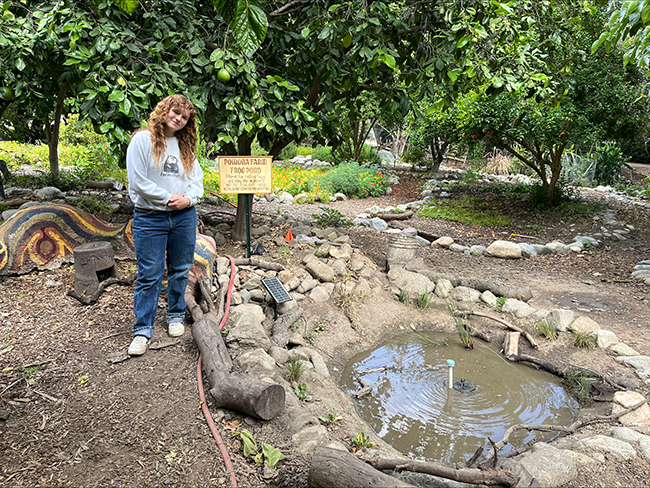
Anna Parrott created a new pond at Pomona College’s Farm as a habitat for frogs. Photo/courtesy of Pomona College
by Marilyn Thomsen | Special to the Courier
In Pomona College’s Frank Dining Hall, an overnight oats bar tempts students to enjoy a plant-based breakfast. Throughout the campus, facilities staff are identifying pest control methods that avoid harm to vital pollinators.
At the campus Organic Farm, a newly created pond is a habitat for amphibians and reptiles.
Each of these student-led projects was made possible by grants from the school’s President’s Sustainability Fund, established to encourage student environmental initiatives.

Nikhil Schneider, assistant director of sustainability at Pomona College, shows locks available in the school’s Green Bikes’ U-lock check-out program. Photo/by Marilyn Thomsen
Over the recent spring semester, nine approved projects received a total of $13,200. Alexis Reyes, the college’s director of sustainability and energy management, who oversees the grants, credits 2026 grad Sydney Tai, ASPC’s commissioner for facilities and the environment, with providing a matching ASPC grant to increase project funding.
The projects tackled issues ranging from dining hall food waste to automatic lighting in residence halls and water bottle refill stations.
“Since the PSF was established in 2007, it has awarded over $100,000 for student projects,” Reyes said. “Many of the sustainability programs we have today started as PSF pilot projects, including the dining hall compost program, reusable greenware dishes for events, drying rack check-outs, the water bottle refill station at Smith Campus Center and green bikes’ U-lock check-out program.”
Pomona students Nora Wilcox, Penelope Wu, and Jaden Yang began their efforts to increase plant-based dining options during the fall semester, even before obtaining the grant. They have been working with executive chef Travis Ellis to adopt the forward food pledge. “It’s a commitment to 50% plant-based food in roughly five years,” said Yang, a physics and politics major. The pledge is an effort of the Humane World for Animals organization. Signatories include a number of colleges and universities, including UCLA, UC Berkeley and the University of Texas at Austin.
“Right now, there’s a trend of protein emphasis on social media that includes a lot of meat and dairy products. People are thinking that the plant-based diet is no longer a healthy option,” Wu said, adding this is especially true of athletes who worry they won’t get enough protein. “Reality is, you can get enough protein from a plant-based diet. It’s important that we educate college students and the community that plant-based is very nutritious, sustainable and delicious.”
The three project leaders recognize that many students want meat options in Pomona’s dining halls, and menus will continue to include them. They’ve been working with Ellis to make changes gradually to avoid pushback. And they recently held a taste test event that gave students a chance to try plant-based food already served in the school’s dining halls.
Yang said a survey they carried out early in the school year showed well over half of Pomona students, regardless of their preferred diet, want to see more plant-based dining options.
Eating more plant-based food “doesn’t mean you’re becoming vegan and you’re never going to eat meat again,” Wilcox said. “It’s just being more conscious of your impact on the earth.”
When Pomona College student Isha Raheja was in high school, the beehive she kept was completely wiped out when a neighboring school administered pesticides to manage a wild hive. “Pesticides can drift several miles and affect not only target species but also beneficial insects and pollinators,” Raheja said. “We are currently living in what scientists have dubbed ‘an insect apocalypse.’”

A recent tasting event at Pomona College’s Frary Dining Hall showcases plant-based food options. Photo/by Marilyn Thomsen
Raheja and project partner Kitty Chadwyck-Healey aim to help Pomona reduce harmful effects of pest control products while safely managing pests to guard human health. They partnered with the campus facilities and campus services, sustainability office, and the college’s pest control vendor to map out when and where various products were administered. They then developed a toxicity database and designed a pilot program with organic pest control options.
“We wanted to establish the best green alternatives to pilot at the most impactful locations,” Raheja said. “We wanted to ensure facilities would have data-informed insights for a potential green transition or future integrated pest management plan.”
Earlier this month Raheja brought a beehive to the Pomona College Organic Farm. She hopes that through careful pest management at the college, these bees will not suffer the same fate as those in her high school hive.
Anna Parrott began working at the farm during her first year at Pomona. An environmental analysis major with an emphasis in biology, she also leads the farm club, which holds social events to get students engaged with the farm. A farm fest, for example, drew more than 100 people to hear bands under the trees and eat food grown on the property.
A herpetology class piqued Parrott’s interest in how the farm could not just grow food but also be a supportive amphibian and reptile habitat. In response, she built a small pond that she hopes will become a home for local frogs. The water is not chemically treated, and there are no fish or invasive turtle species that would eat the frog eggs.

Isha Raheja introduces a beehive to Pomona College’s Farm. Photo/courtesy of Pomona College
Parrott aimed to engage students with the pond. “At the beginning of the semester we had this event that was cheekily labeled ‘dig a hole’ at the farm,” she said. “We had 10 people show up, which was more than enough to dig the hole. It was so fun.”
Parrott decided to line the pond walls with bentonite, a type of absorbent clay composed mainly of volcanic ash that expands and seals. Finding the right technique for applying the bentonite to the dirt surfaces to make the pond waterproof required trial and error. Several times when the pond leaked and became a mud hole, she had to dig out the clay and start all over again. But she said it was worth the hard work in order to avoid using plastic. “We don’t really know the impact of microplastics on people or animals, and we do know that frogs are really sensitive to changes in water quality,” she said. “So it felt like something that we could do to perhaps provide a better habitat for these frogs.”
Related






0 Comments