




The CUSD Board of Education votes yes as a bloc. Why?
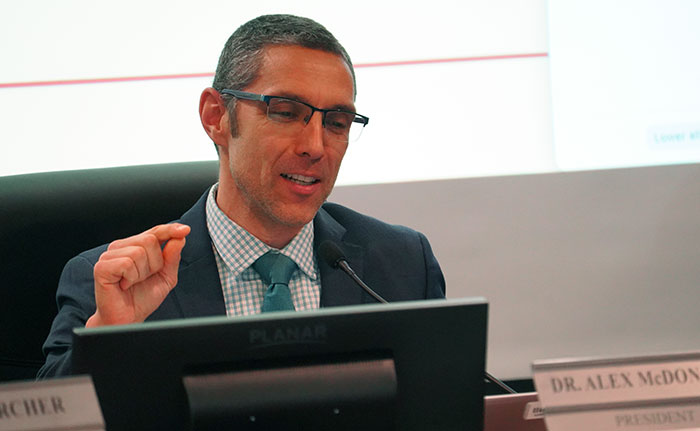
CUSD Board of Education President Alex McDonald. Courier photo/Andrew Alonzo
by Andrew Alonzo | aalonzo@claremont-courier.com
In 2025, the five-member Claremont Unified School District Board of Education took 160 public votes, and 156 of them were unanimous approvals.
The non-unanimous decisions were:
- A March 6, 2025 motion on a closed session item, “To approve the recommendation of the Hearing Panel for Pupil Case No 20250306A,” which resulted in a 4-1 rejection, with board member Cherly Fiello the lone yes vote. It was the only public “no” decision the board took in 2025.
- A March 20, 2025 motion on regular meeting item, “To authorize the proposed research “Cleaner Air Greener Schools Program by Liz Christy, Education Programs Manager, US Green Building Council-CA,” was approved 4-1, with Fiello voting no.
- A April 17, 2025 motion on closed session item, “To deny the allegation brought forth in Pupil Case No 20250306A and uphold student record,” that saw board members Kathy Archer and Richard O’Neill abstain, yielding a 3-0 yes majority despite all board members being present. It was the sole instance that year in which a board member abstained from a vote.
- An August 21, 2025 motion on closed session item, “To readmit Student 20250807A,” which was approved by a 3-2 with Fiello and Archer voting against.
Across 23 meetings in 2025, just seven “no” votes were cast — Kathyrn Dunn, Archer, O’Neill, and Alex McDonald voted no on March 6; Fiello on March 20; and Fiello and Archer on August 21.
“The data you’re sharing is not surprising, let’s put it that way,” said Board President McDonald. “I think part of the reason why is the board is all really focused on what’s best for students … and because we’re focused on that, we tend to be very much in alignment.”
Board members Archer, Dunn, Fiello, and O’Neill declined to be interviewed for this story, citing board policy bylaw 9010, which reads in part, “All public statements authorized to be made on behalf of the Board shall be made by the Board president or, if appropriate, by the Superintendent or other designated representative.”
McDonald said collaborative efforts behind the scenes between board members, CUSD Superintendent Jim Elsasser, and other district administrators help to refine policy and solidify decisions long before they go before the public for a vote.
“They bring forward really, really good policy and really good, well thought out, well vetted ideas,” McDonald said. “So, by the time it gets to the board level, it’s already been through multiple layers of iterations and revisions and so the board is just that final kind of approval, if you will. By the time the board policies come to the district, most of the work has already been done essentially.
“So rather than making a long, prolonged, messy board meeting, we really strive for collaboration and consensus, working through the superintendent, working through the district staff. So I think that’s part of the reason why it seems that we always are just in agreement, because so much work has been done ahead of time.”
McDonald expanded on the board’s role.
“Our job as the board is to set the direction and set the policy for the district based on community studies, teachers, staff, stakeholder input,” he said. “The board sets the policy and sets the direction; it sets the destination for the district. And really, we focus and rely on the experts and the teachers and the staff and administrators to figure out how best to get us there. It’s a very collaborative effort.”
McDonald was asked to respond to critics who have said the board’s near total agreement on every issue brought before it in public meetings constitutes an avoidance of debate and denies constituents of an opportunity to influence decisions.
“High quality, effective governance doesn’t have to just create discord, honestly,” McDonald said. “And just because our votes were unanimous is not necessarily a reflection on the hard work and the effective leadership we have as a board and within our student body and our community district also.”
McDonald spoke more about the board’s effectiveness and efficiency:
“I can’t speak to other board members minds or votes,” he said. “I do know that our process is very well established. I know that I am able to understand and have a lot of my questions addressed ahead of time or a lot of my concerns addressed ahead of time before a policy comes to the board, so that we can get our work done efficiently. So, just because we’re all in alignment for the final votes, I don’t think that means that we’re hiding anything or we’re rubber stamping. That’s not the case at all. I think we all do a tremendous amount of work behind the scenes so that we can get our work done efficiently and collaboratively.”
McDonald explained why closed session votes are sometimes not undisputed.
“Those issues can be more challenging when it comes to student discipline and things like that and really wanting to help support our students as best we can,” he said. “There’s a lot of sort of variability in terms of how that can be done. And I think the reason a lot of the closed session items were not unanimous was because a lot of those issues are a little bit more gray. It’s not always as clear cut what’s best for individual students or a student body as a whole … Those issues are not always as straightforward. There’s lots of gray area in terms of how we should best support our students as individuals. Then the public votes are more on broader policy issues that affect students across the district.”
McDonald, who is a medical doctor, said he’s happy to be serving and plans to seek re-election for a four-year term this fall.
“I love being that link between the community and the district and policy levels,” McDonald said. “Again, the reason I ran for school board is because education is foundational to good health. And if I can help bring my perspective and my ability to help improve the education of our students within Claremont, we’re going to ultimately improve their health and the health of our community overall.”
Related







0 Comments